Three months with a turbine car
No carmaker had ever lent an experimental car to the public. Chrysler lent 50 of them to 203 people, and wrote down everything that went wrong.
Who could take part
Chrysler announced the loan plan on 14 May 1963. Within six weeks 30,000 people had written in asking to take part; 203 drivers were chosen, 23 of them women. Hemmings (Michael Lamm)
An accounting firm, Touche, Ross, Bailey and Smart, picked users at random from the file of unsolicited requests, to criteria Chrysler set. J. M. Sturm, Chrysler, 1965
To qualify you needed a valid driving licence and a car in the household. Users came from the main population centres of the 48 contiguous states. J. M. Sturm, Chrysler, 1965 Selection also took account of the make, price bracket and age of the car the applicant already owned. J. M. Sturm, Chrysler, 1965
The rules
Each user had a car for three months under a no-charge agreement; then it went to the next. J. M. Sturm, Chrysler, 1965
Chrysler paid for maintenance, registration and insurance during each loan. Hemmings (Daniel Strohl), 2013
Users were expected to drive normally: no racing, no hauling. J. M. Sturm, Chrysler, 1965
Leno says users had to keep a diary of what they liked, what they didn’t, and what went wrong. Hagerty (Jay Leno), 2021
A Turbine Service Coordinator, from one of six centres around the country, kept in touch with each user. J. M. Sturm, Chrysler, 1965
Who got one
The first car went to a young computer systems engineer in Chicago on 29 October 1963. J. M. Sturm, Chrysler, 1965
Later users included an admiral in Washington, a woman industrial designer in New York, a barber in Detroit and a housewife in Tacoma. J. M. Sturm, Chrysler, 1965
Sixty percent of testers already drove Chrysler products. Their ages ran from 21 to 70, and about 10 percent were women. J. M. Sturm, Chrysler, 1965
By 13 May 1965, cars had gone to 160 families in 114 cities in 44 states and the District of Columbia, and the first 158 users had driven about 770,000 miles. J. M. Sturm, Chrysler, 1965
The Smithsonian’s car was shared in turn by three families around Baltimore and one in Washington. Smithsonian
One family’s car
Mark Olson’s family had one from 13 May to 13 August 1965; his mother, Beulah, wrote a poem about it. Hemmings, 2018
The speech Chrysler gave at that handover, at a motel in Duluth, Minnesota, survives on Olson’s website. J. M. Sturm, Chrysler, 1965
Not all 50 went to families
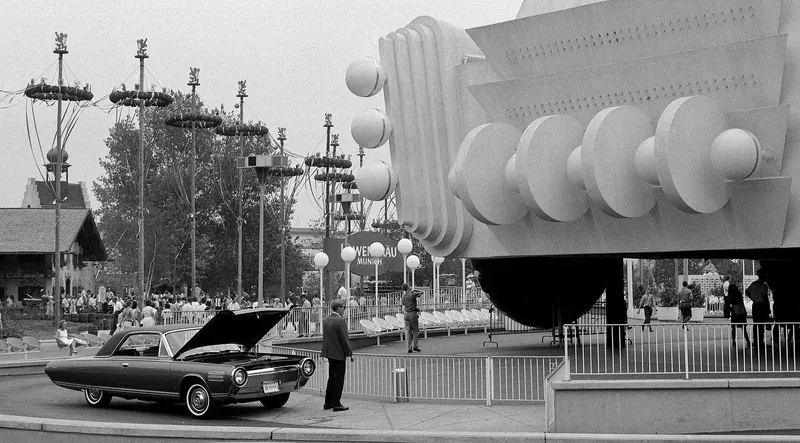
Daniel Strohl’s count is that 46 of the 50 went to users: two went to the 1964 New York World’s Fair and two to other Chrysler publicity work. Hemmings (Daniel Strohl), 2013
At the New York World’s Fair, visitors could ride in the cars round a small track. Road & Track (Lehto), 2017
Keeping 50 cars running
Five field service men and two supervisors looked after all 50 cars across the country. George Huebner, Chrysler, 1966
Days lost to faults fell from just over 4 percent early on to just over 1 percent. George Huebner, Chrysler, 1966
Some drivers moved the selector out of the start position before the engine reached idle, overheating it. Chrysler changed the start system so drivers could not override it. George Huebner, Chrysler, 1966
The worst trouble was the combined starter-generator: at high altitude and low humidity its brushes wore out fast. Chrysler concluded that future turbines needed a separate starter and alternator. George Huebner, Chrysler, 1966
Cold starting proved as good as claimed, and users liked instant cabin heat and having no antifreeze to think about. George Huebner, Chrysler, 1966 Lost power could be restored almost at once by feeding a cleaning compound into the intake. George Huebner, Chrysler, 1966
Only one car reached 50,000 miles in the two years, but Huebner expected most parts to pass 100,000. George Huebner, Chrysler, 1966
What the users thought
At the end, most volunteers said they would buy a turbine car at a competitive price. The grumbles were about fuel mileage and sluggish acceleration. Hemmings (Michael Lamm)
The Henry Ford sums it up: users loved the low maintenance and lack of vibration, but complained about slow acceleration and poor fuel economy. The Henry Ford
No user had a major problem: no explosions, nothing burnt or singed, nobody stranded. Hemmings (Michael Lamm)
Fuel economy: sources differ
How many miles per gallon? Sources differ
- Huebner admitted fuel mileage was “not quite as good” as a comparable piston car’s, and blamed it partly on all the starts and stop-and-go driving while users showed the car off. George Huebner, Chrysler, 1966
- Lamm, quoted by Hemmings, gives roughly 11.5 mpg at part throttle. Hemmings (Mark McCourt)
- The Detroit Historical Museum lists 17.25 mpg. Detroit Historical Museum
- Leno says he gets about 20 mpg. Hagerty (Jay Leno), 2021
These aren’t measured the same way: Lamm’s figure is for part throttle, Huebner compares with piston cars rather than giving a number, and Leno is describing his own car decades later.
The totals
The public programme began on 29 October 1963 and ran for 27 months, ending in January 1966. Hemmings (Michael Lamm)
The 203 drivers lived in 133 cities across the United States, and between them drove more than a million miles. Stahls Chrysler’s director of research, George Huebner, put the programme’s total at 1.1 million miles. George Huebner, Chrysler, 1966
When did it run? Sources differ
- The public programme began on 29 October 1963 and ran for 27 months, ending in January 1966. Hemmings (Michael Lamm)
- CBS Detroit dates the test programme to 1964 to 1966. CBS Detroit, 2025
Chrysler’s own 1965 speech dates the first delivery to 29 October 1963, so we use that.
Timeline
- 14 May 1963 Chrysler announced the loan plan on 14 May 1963. Within six weeks 30,000 people had written in asking to take part; 203 drivers were chosen, 23 of them women. Hemmings (Michael Lamm)
- 29 Oct 1963 The first car went to a young computer systems engineer in Chicago on 29 October 1963. J. M. Sturm, Chrysler, 1965
- 1964 At the New York World’s Fair, visitors could ride in the cars round a small track. Road & Track (Lehto), 2017
- 13 May 1965 By 13 May 1965, cars had gone to 160 families in 114 cities in 44 states and the District of Columbia, and the first 158 users had driven about 770,000 miles. J. M. Sturm, Chrysler, 1965
- Jan 1966 The public programme began on 29 October 1963 and ran for 27 months, ending in January 1966. Hemmings (Michael Lamm)
- 12 Apr 1966 Chrysler’s director of research, George Huebner, put the programme’s total at 1.1 million miles. George Huebner, Chrysler, 1966