Tall tales about the Turbine Car
It ran on perfume! It melted bumpers! Chrysler crushed them for tax! Some of this is true, some isn’t, and some nobody can quite pin down.
MythIt was a jet car, pushed along by its exhaust.
FactIt is a turbine car, not a jet car. Instead of using thrust, a second turbine stage takes power from the gas flow, through a 10:1 reduction gear. Hagerty, 2023
MythThe exhaust was hot enough to melt the car behind or scorch the road.
FactRosenbusch: the exhaust does not get hot enough to burn the ground. Hagerty, March 2021 Lehto says the exhaust was cooler than that of piston cars of the day, and Chrysler staff used to hold their hands behind the tailpipes to prove it. Road & Track (Lehto), 2018 The 2,000-degree figure on the dash was the turbine inlet temperature, measured upstream. The gas then passed through a regenerator and a long, winding exhaust before it left the car. Road & Track (Lehto), 2018
MythImport duty is the whole story of why they were destroyed.
FactLehto wrote in 2021 that Chrysler had paid only temporary import duties on most of the cars, so they had to be destroyed or shipped out of the country. Road & Track (Steve Lehto), 2021 Carry, writing in 2013, remembered the duty had dropped to next to nothing by then. The decision was about control: nobody wanted Turbine bodies running round with piston engines in them. Hemmings (Strohl), 2013 Hemmings adds that if duty was due, it must have been paid on the nine survivors, and Chrysler had been willing to give every car to a museum. Hemmings (Strohl), 2013 Rosenbusch says Chrysler, like every carmaker, didn’t want prototypes on the road, or someone swapping in a 318 or a Hemi, and that most were not destroyed to dodge import tariffs. Hagerty, March 2021
MythAnyone could buy one.
FactThey were never for sale. Users had unrestricted use of a car for up to three months, in return for keeping it in good order and reporting back to Chrysler. Hemmings, 2018 Each user had a car for three months under a no-charge agreement; then it went to the next. J. M. Sturm, Chrysler, 1965
MythIt was the only turbine car Chrysler ever made.
FactRosenbusch also stresses that the 1963 cars were not the last Chrysler turbine cars. Hagerty, March 2021 Chrysler kept going through seven generations of turbine, in trucks, pickups, Aspens and Volarés. The last two cars were a 1978 LeBaron and a 1981 Dodge Mirada. Hagerty, March 2021
MythUsers kept breaking down and getting stranded.
FactNo user had a major problem: no explosions, nothing burnt or singed, nobody stranded. Hemmings (Michael Lamm) Days lost to faults fell from just over 4 percent early on to just over 1 percent. George Huebner, Chrysler, 1966
MythThat jet whine is just what turbines sound like.
FactHuebner said the sound people link with jet turbines comes mainly from accessory drive gears, not the turbine itself, and that Chrysler was making its engines quieter with different gears, slower accessories at idle and new intake silencers. George Huebner, Chrysler, 1966
MythNone of them survive.
FactOnly nine survive. Chrysler kept three and gave six to museums; the other 46 were destroyed. Road & Track (Steve Lehto), 2021 Stahls says the car is on display there, and visitors can see it and sometimes hear it. Stahls
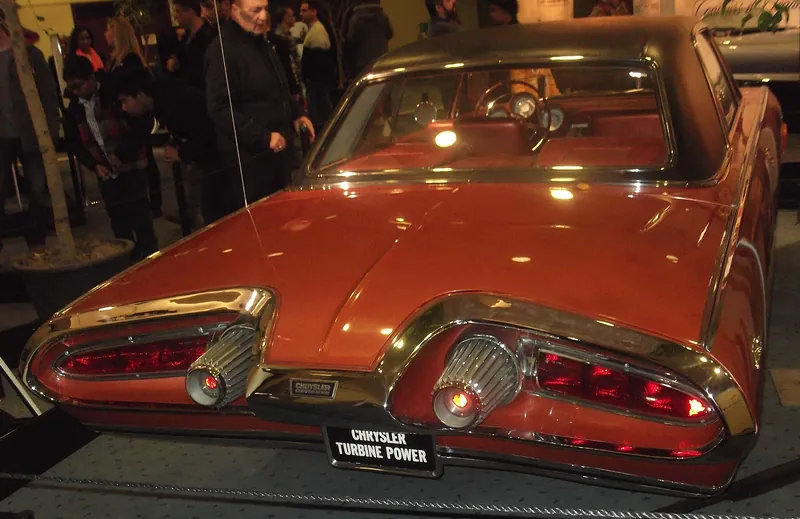
Where the hot-exhaust idea came from
The worry wasn’t pure fantasy: Ford’s late-1950s Thunderbird with a non-regenerative aircraft turbine would set fire to roadside grass. Hemmings (Michael Lamm)
Leno says the heat from the tailpipe is actually lower than from a piston engine. Hagerty (Jay Leno), 2021
The famous fuels
The Turbine Car’s party trick was running on almost anything. Some of the stories are well documented; others are second-hand at best.
Diesel, kerosene and heating oil: documented
Users paid only for fuel, usually diesel, kerosene or unleaded petrol. Leaded petrol worked, but Chrysler found the lead damaged the engines. Hemmings (Daniel Strohl), 2013
A third-generation CR2A turbine took a 1962 Dodge Dart from New York to Los Angeles in four days, running on petrol, diesel, kerosene and JP4 jet fuel. Hemmings (Mark McCourt)
Peanut oil: documented
The Henry Ford says it could run on petrol, diesel, kerosene, even peanut oil, which made the exhaust smell like baking cookies. Fuel economy was the weak point. The Henry Ford (Matt Anderson)
Hagerty tells how Chrysler engineer Jerry Gross took a car to a peanut festival and ran it on peanut oil. It smelled like a restaurant kitchen, but ran fine. Hagerty, 2023
Tequila, in Mexico: well told, details differ
The tequila story: two versions
- Lamm’s version of the tequila story: one of the five research cars was lent to Chrysler’s International Division to tour other countries. In Mexico, President Adolfo López Mateos asked to run it on tequila. Huebner had two gallons bought, ran them through a lab engine, and gave the go-ahead. Hemmings (Michael Lamm)
- Lehto’s version: the president offered to supply the tequila; the Chrysler PR man phoned Detroit; engineers ran a few gallons through a turbine; and the president got a quick ride on it. Road & Track (Lehto), 2017
Both versions agree that Huebner had tequila tested on an engine in Detroit first, and that the car then ran on it. They differ on who supplied the tequila, how much was used, and whether the president drove or was driven. We have not seen a primary record of the day itself.
Chanel No. 5, in France: poorly sourced
The perfume story: sources differ
- Lamm lists Chanel No. 5 among the fuels it ran on, saying someone had poured it into one of the cars. Hemmings (Michael Lamm)
- Leno says that in France it ran on Chanel No. 5. Hagerty (Jay Leno), 2021
- Hagerty’s 2023 piece introduces it with “another story goes”: someone in France once ran a car on Chanel No. 5. Hagerty, 2023
- Lehto calls the Chanel No. 5 and VO5 hairspray stories rumours. Road & Track (Lehto), 2017
None of these gives a date, a place more exact than “France”, or a witness. Treat it as a good story rather than a fact.
Fuel economy, meanwhile, was a real weakness: see the loan programme page.