Two turbines, a blowtorch and some very clever plumbing
No pistons, no valves, no crankshaft and no radiator. Here is how the A-831 worked, and what it was like to drive.
A turbine car, not a jet car
It is a turbine car, not a jet car. Instead of using thrust, a second turbine stage takes power from the gas flow, through a 10:1 reduction gear. Hagerty, 2023
Michael Lamm’s picture is a blowtorch and three fans. A compressor pushes air in, fuel burns, and the hot gas spins a compressor turbine on the same shaft. Beyond it, with no mechanical connection at all, a separate power turbine drives the car. Hemmings (Michael Lamm)
The engine was Chrysler’s fourth-generation gas turbine, designated A-831. Hemmings (Mark McCourt) With a 4:1 compression ratio it made 130 hp at 3,600 rpm at the output shaft, and 425 lb ft of torque at stall. Hemmings (Mark McCourt)
For comparison, see how a four-stroke piston engine works on engines.motoring.im, and the other ways to power a car people have tried.
The two clever bits
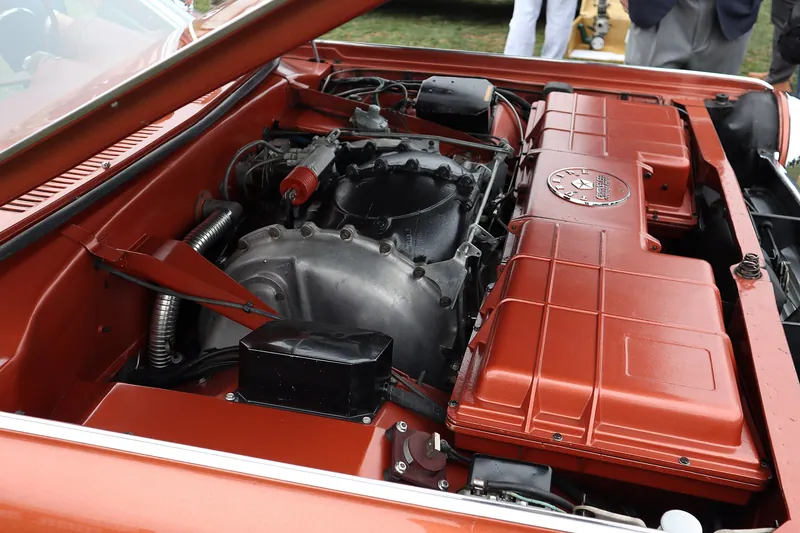
Two ceramic regenerators, one each side of the burner, took heat from the exhaust and passed it to the incoming air. A single nozzle sprayed in the fuel. Hemmings (Mark McCourt)
Each regenerator was a spinning heat exchanger. Exhaust went in at more than 1,000°F and came out at about half that. Hemmings (Mike McNessor)
A ring of 23 variable blades, moved hydraulically according to the throttle, aimed the gas at the power turbine. Lifting off turned them against it, giving some engine braking. Hemmings (Mike McNessor)
Fewer parts
Lamm says a gas turbine has about a fifth as many parts as a piston V-8: no pistons, valves, crankshaft or camshaft, and no radiator in the normal sense. Hemmings (Michael Lamm)
The Hagerty Drivers Foundation puts it as 80 percent fewer reciprocating parts than a piston engine. Hagerty Drivers Foundation
It had one igniter instead of a set of spark plugs, never needed a tune-up, and gave hot air to the cabin straight away. Hemmings (Michael Lamm)
It swallowed about four times as much air as a piston engine, which is why it had a huge air filter housing. The Henry Ford (Matt Anderson)
Into the gearbox
Power went to the rear wheels through a modified three-speed TorqueFlite automatic with no torque converter. Hagerty Drivers Foundation
Lamm explains why: the engine’s own gases, passing between the first and second turbine stages, did the torque converter’s job. Hemmings (Michael Lamm)
How much power, measured where? Sources differ
- The Henry Ford lists 130 horsepower at 3,600 rpm, measured at the output shaft, and a weight of 3,900 lb. The Henry Ford
- With a 4:1 compression ratio it made 130 hp at 3,600 rpm at the output shaft, and 425 lb ft of torque at stall. Hemmings (Mark McCourt)
- Chrysler’s 1965 handover speech said the turbine delivered 130 rated horsepower to the rear wheels. J. M. Sturm, Chrysler, 1965
- Chrysler said the engine weighed 410 lb, made 425 lb ft of torque, and gave the car the performance of a 230 hp V-8 that weighed twice as much. J. M. Sturm, Chrysler, 1965
Hot inside, cool outside
Inside, the compressor turbine wheel ran at 1,500°F at full power, in gas at 1,700°F. Chrysler developed its own low-cost, mainly iron alloys for these hot parts. George Huebner, Chrysler, 1966
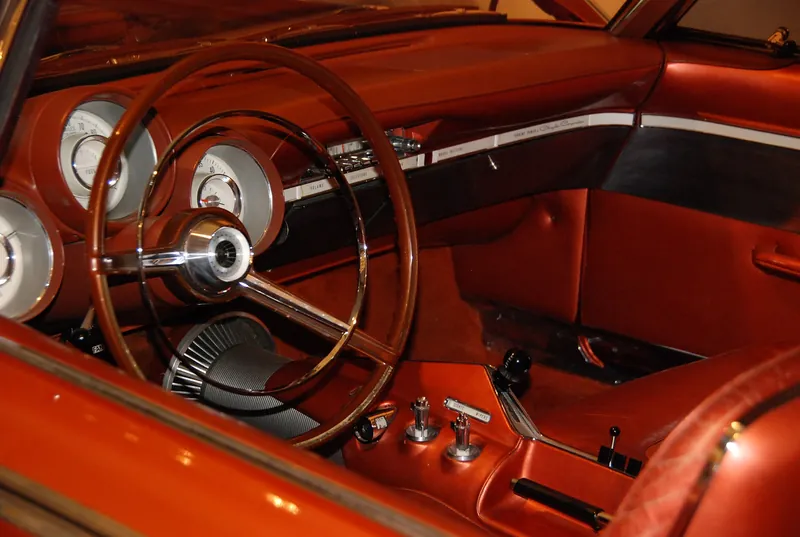
The 2,000-degree figure on the dash was the turbine inlet temperature, measured upstream. The gas then passed through a regenerator and a long, winding exhaust before it left the car. Road & Track (Lehto), 2018
How fast it spun
Every source agrees the turbine spun far faster than a piston engine. They don’t agree on the numbers.
Idle and top speeds: sources differ
- One Hemmings article gives an idle of about 8,000 rpm and 50,000 rpm at full throttle. Hemmings (Mark McCourt)
- Steve Lehto says the rev counter read to 60,000 rpm and the car idled at over 10,000. Road & Track (Lehto), 2018
- The Hagerty Drivers Foundation gives its working range as over 18,000 to 45,000 rpm. Hagerty Drivers Foundation
- Hagerty says the Stahls car idles at 18,000 to 22,000 rpm and cruises comfortably at about 70 mph. Hagerty, April 2021
- Jay Leno says his idles at 22,000 rpm and revs to 50,000. Hagerty (Jay Leno), 2021
The 8,000 rpm idle looks borrowed from a general description of turbines. Lamm writes that a typical gas turbine idles at about 8,000 rpm and turns roughly 50,000 at full throttle. Hemmings (Michael Lamm) That is about turbines in general, not the A-831, so we treat it with caution. The figures from people who own and run cars today are in the 18,000 to 22,000 range.
The catch: lag, thirst and no engine braking
Turbines can be slow to spool up, burn the most fuel at low and varying speeds, and give no natural engine braking. Hemmings (Mike McNessor)
Huebner said the gas generator took 7 seconds to go from idle to full power in the 1954 to 1959 engines, 3 seconds in 1962, and 1.5 to 2 seconds in the 50 cars. George Huebner, Chrysler, 1966
He gave 0 to 60 mph as generally around 12 seconds, on an 85°F day. George Huebner, Chrysler, 1966
Lamm says that if you held the brake and floored the throttle to wind the turbine up first, a typical turbine car would do 0 to 60 in about 5.5 seconds, and the A-831 cars could manage figures like that. Chrysler never told its users to drive that way. Hemmings (Michael Lamm)
What it was like to drive
Lamm drove one in Los Angeles in 1963 and remembered a mushy, rubber-band feel. Hemmings (Michael Lamm)
Leno says his accelerates much like a Dodge Dart with a 318 V-8, but is incredibly smooth. Hagerty (Jay Leno), 2021
To show the lack of vibration, Leno has stood a glass of water on the engine cover; it barely ripples. Hagerty, March 2021
At handovers Chrysler asked new users to notice the smooth response, the lack of vibration and the low engine noise at normal speeds. J. M. Sturm, Chrysler, 1965
Starting took care. The instructions said to shut down above 1,600 degrees, and to wait until the engine was below 1,500 before moving off, or it would flame out. Hagerty, March 2021
The sound
Leno remembers watching one “whoosh around” at the 1964 New York World’s Fair. Hagerty (Jay Leno), 2021
Huebner said the sound people link with jet turbines comes mainly from accessory drive gears, not the turbine itself, and that Chrysler was making its engines quieter with different gears, slower accessories at idle and new intake silencers. George Huebner, Chrysler, 1966
What it ran on
Users paid only for fuel, usually diesel, kerosene or unleaded petrol. Leaded petrol worked, but Chrysler found the lead damaged the engines. Hemmings (Daniel Strohl), 2013
Lamm says most users followed Chrysler’s advice and ran on No. 2 diesel or white gasoline, because the lead in pump petrol eroded the turbine fins. Hemmings (Michael Lamm)
Lehto says the loan cars often ran on diesel and home heating oil. Road & Track (Lehto), 2017
The Henry Ford says it could run on petrol, diesel, kerosene, even peanut oil, which made the exhaust smell like baking cookies. Fuel economy was the weak point. The Henry Ford (Matt Anderson)
The more colourful fuel stories, from tequila to perfume, are on the myths page, with the evidence for each.
Next: the loan programme →