From a wartime aircraft engine to 50 bronze coupes
Chrysler spent ten years putting turbines into ordinary cars before it built one specially. Then it gave them away, for three months at a time.
The loan cars, not the show cars. This site is about Chrysler’s 55 Ghia-bodied Turbine Cars and the public loan programme of 1963 to 1966, not GM’s Firebirds or Chrysler’s earlier test cars. See the home page for the difference.
An aircraft engine first
The story starts with an aircraft engine. Just as the Second World War was ending, Chrysler finished a turboprop design codenamed A-86, then dropped it. Hagerty, 2023
In 1953 Chrysler turned its turbine work towards cars. Hagerty, March 2021
The late-1953 engine was among the first to use its own hot exhaust to warm the incoming air, which cut both fuel use and exhaust temperature. Hemmings, 2018
Turbines on the road
Its first turbine car was a 1954 Plymouth. A turbine 1956 Plymouth then completed a 3,020-mile cross-country road test. Hagerty, March 2021 Hemmings says that 1956 Plymouth went from New York to Los Angeles averaging 13 mpg. Hemmings, 2018
Two years later a 200 hp turbine took a 1959 Plymouth four-door hardtop from Detroit to New York. Hemmings, 2018
A third-generation CR2A turbine took a 1962 Dodge Dart from New York to Los Angeles in four days, running on petrol, diesel, kerosene and JP4 jet fuel. Hemmings (Mark McCourt)
Everyone was trying
Chrysler was not alone: GM, Ford, Fiat, Kenworth and many others looked into turbines. Chrysler was the only maker to develop a turbine car for the public to use. Hemmings (Daniel Strohl), 2013
In Britain, Rover had put a turbine in a car as early as 1949. Hagerty, 2023
General Motors began its own turbine programme in 1951 and showed turbine-powered Firebird show cars in the mid-1950s. Hemmings (Michael Lamm)
It was an era of big ideas about the car of the future. For one that never got further than a scale model, see the Ford Nucleon on nucleon.motoring.im.
A car built for the job
Chrysler announced on 14 February 1962 that it would build 50 specially designed turbine cars for consumer testing. J. M. Sturm, Chrysler, 1965
The car was designed under Elwood Engel and pushed along by George Huebner, Chrysler’s chief engineer of research. Hemmings (Daniel Strohl), 2013
Chrysler said it deliberately made it a familiar family car, with styling “functional and uncontroversial”, so that people would judge the engine. J. M. Sturm, Chrysler, 1965
The Smithsonian points to the bodies’ “turbo motif”, meant to show off the promise of jet power. Smithsonian
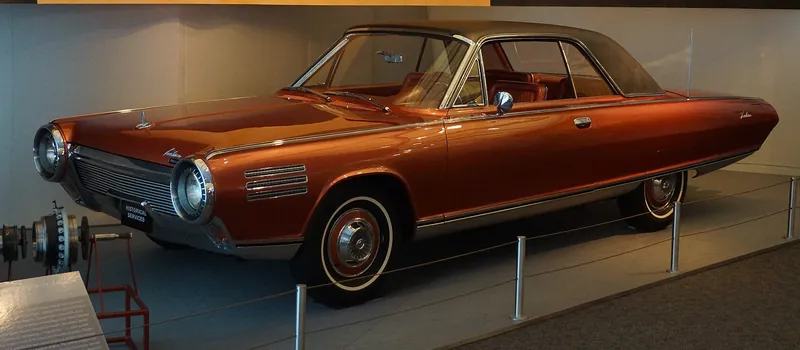
Italian bodies, Detroit everything else
Chrysler built 55 metallic bronze two-door hardtops powered by gas turbines. Their bodies were hand-built in Italy by Carrozzeria Ghia in 1963 and 1964. Hemmings (Mark McCourt)
Huebner said Ghia only hand-formed the bodies, beating the panels into shape without dies. The design was American, and the steel, glass and upholstery were all shipped from the US. Hemmings (Michael Lamm)
The finished, trimmed bodies were shipped from Italy to a small rented plant on Greenfield Road in Detroit, where Chrysler Research built the engines and chassis and joined them up. Hemmings (Michael Lamm)
Where were they put together? Sources differ
- The finished, trimmed bodies were shipped from Italy to a small rented plant on Greenfield Road in Detroit, where Chrysler Research built the engines and chassis and joined them up. Hemmings (Michael Lamm)
- The Detroit Historical Museum says instead that Chrysler hand-built the 50 cars at its Highland Park design studio. Detroit Historical Museum
Huebner put the cost of each car at $50,000 to $55,000. Almost nothing on them interchanged with production Chryslers. Hemmings (Michael Lamm)
Chrysler’s historian Brandt Rosenbusch says the turbine engine alone cost $10,000 or more to make, when a mid-range car cost about $3,000. Hagerty, March 2021
Under the skin
Underneath was a unitised body with coil-spring front suspension, instead of the torsion bars Chrysler normally used. Hemmings (Daniel Strohl), 2013 The front subframe was an experiment in a fully isolated front suspension. It worked well but cost too much ever to reach production. Hemmings (Michael Lamm)
Huebner described it as a small luxury car with power steering, brakes and windows, and two extra gauges for turbine speed and temperature. George Huebner, Chrysler, 1966
The Henry Ford’s car is 201.6 inches long on a 110-inch wheelbase. The Henry Ford The Henry Ford lists 130 horsepower at 3,600 rpm, measured at the output shaft, and a weight of 3,900 lb. The Henry Ford
One colour for all
Of the 55, five were prototypes built in 1962 and used for troubleshooting, each slightly different. The other 50 were identical, built between October 1963 and October 1964. National Museum of Transportation
The five prototypes varied in colour and trim. The fleet of 50 all had metallic bronze paint, a black vinyl roof and a bronze interior. Hagerty, March 2021
All 50 of the user cars were finished in the same colour, Turbine Bronze. Hagerty Drivers Foundation
Styling details included three large dash gauges, a centre console with its own controls, tail lights that look like jet burners, and a twin horizontal exhaust. Hagerty, April 2021
Timeline
- Around 1945 The story starts with an aircraft engine. Just as the Second World War was ending, Chrysler finished a turboprop design codenamed A-86, then dropped it. Hagerty, 2023
- 1953 In 1953 Chrysler turned its turbine work towards cars. Hagerty, March 2021 The late-1953 engine was among the first to use its own hot exhaust to warm the incoming air, which cut both fuel use and exhaust temperature. Hemmings, 2018
- 1954–56 Its first turbine car was a 1954 Plymouth. A turbine 1956 Plymouth then completed a 3,020-mile cross-country road test. Hagerty, March 2021
- Late 1950s Two years later a 200 hp turbine took a 1959 Plymouth four-door hardtop from Detroit to New York. Hemmings, 2018
- 1962 A third-generation CR2A turbine took a 1962 Dodge Dart from New York to Los Angeles in four days, running on petrol, diesel, kerosene and JP4 jet fuel. Hemmings (Mark McCourt)
- 14 Feb 1962 Chrysler announced on 14 February 1962 that it would build 50 specially designed turbine cars for consumer testing. J. M. Sturm, Chrysler, 1965
- 14 May 1963 Chrysler announced the loan plan on 14 May 1963. Within six weeks 30,000 people had written in asking to take part; 203 drivers were chosen, 23 of them women. Hemmings (Michael Lamm)
- 29 Oct 1963 The first car went to a young computer systems engineer in Chicago on 29 October 1963. J. M. Sturm, Chrysler, 1965
- Jan 1966 The public programme began on 29 October 1963 and ran for 27 months, ending in January 1966. Hemmings (Michael Lamm)
Next: how the turbine worked →